Corroded foundation vent screens
Original mesh rusts through in Seattle's damp air. A screen that crumbles at a finger's touch is an open door to the crawl space.
Rodents
Trapping removes this year's rats. Exclusion is the only thing that stops next year's. We walk the entire envelope of your home, crawl space vents to roofline, find every quarter-size-and-up opening, and close each one with materials rats cannot gnaw through. Documented with photos, gap by gap.
Call (206) 944-0849 All treatments
Reviewed by Marjorie Tidwell, Pest Prevention Writer. Updated 2026-10-05.
In short: Call (206) 944-0849 to book an exclusion survey. A technician maps every rodent-size opening on the house, foundation vents, pipe and cable penetrations, rooflines, garage corners, quotes the seal as one written number, and closes the list with steel mesh, hardware cloth and gnaw-resistant sealant. Most homes are fully sealed in a day.
What this treatment covers
Exclusion is carpentry-adjacent pest work, and it rewards thoroughness over speed. A rat needs a quarter-size opening and a mouse a dime-size one, so the survey covers the house at that resolution: every foundation vent screen, every pipe and conduit penetration, the gap under the garage door, the corner where two rooflines meet, the chimney flashing, the crawl space hatch, the dryer and bathroom vents. Each opening gets photographed, numbered and listed in the quote.
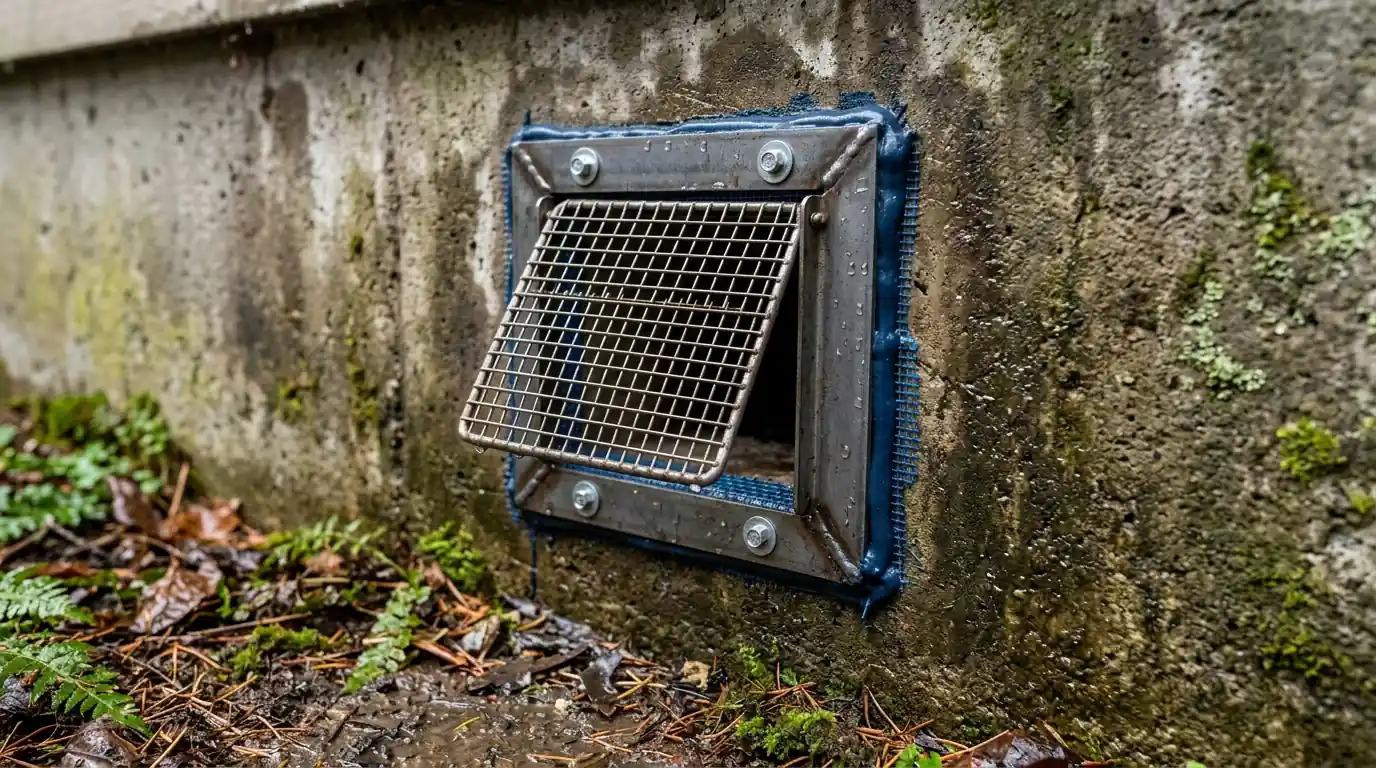
Materials matter because rats test repairs. Expanding foam alone fails in a night; rats gnaw through it. We use quarter-inch galvanized hardware cloth, stainless mesh, sheet metal where profile allows, and sealants rated for the joint, with foam only as a backer behind metal. Vent screens are replaced rather than patched when the original mesh has corroded, which in Seattle's wet air is common on anything older than a couple of decades.
The deliverable is a sealed envelope and the photo set proving it: before and after for every numbered gap. If you are doing exclusion as part of an active infestation, we coordinate it with trapping so no animal is sealed inside; one-way doors handle any stragglers.
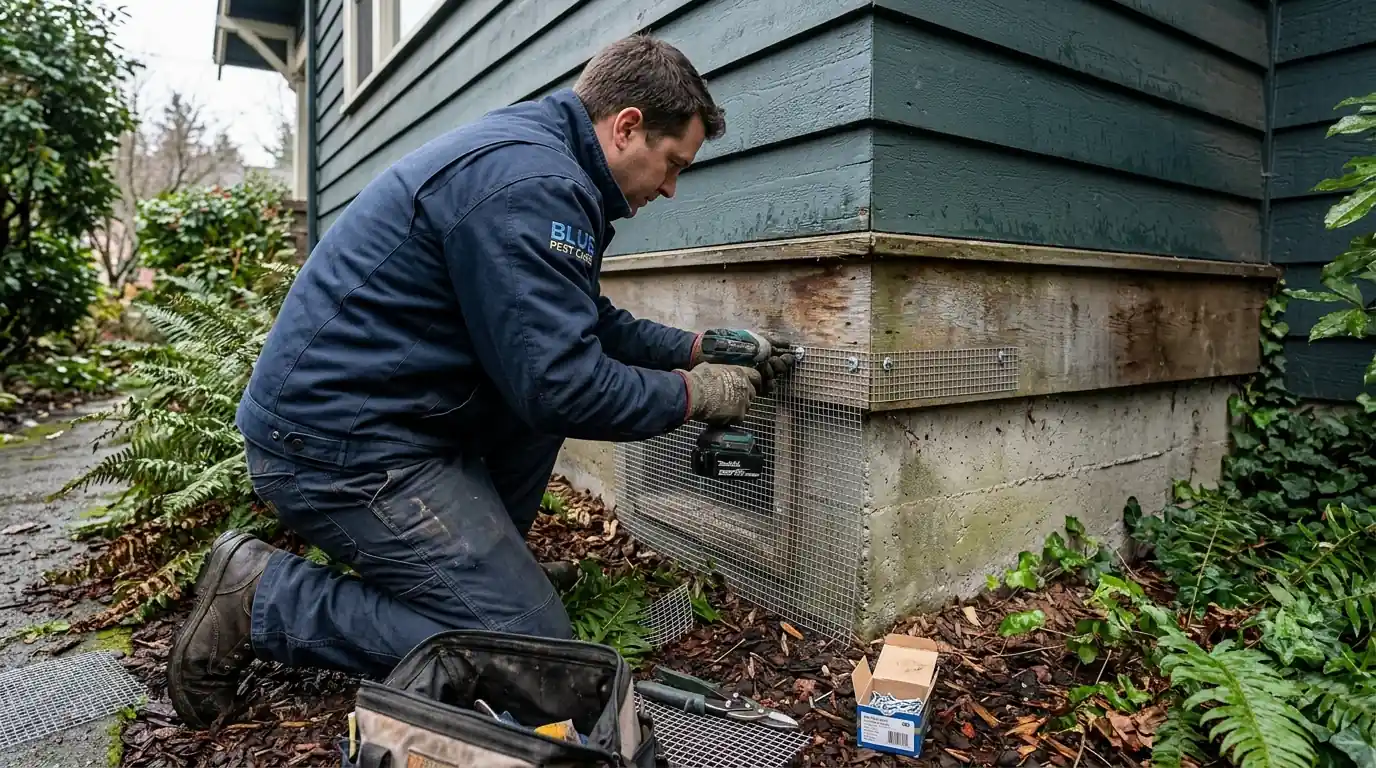
Catch it early
Original mesh rusts through in Seattle's damp air. A screen that crumbles at a finger's touch is an open door to the crawl space.
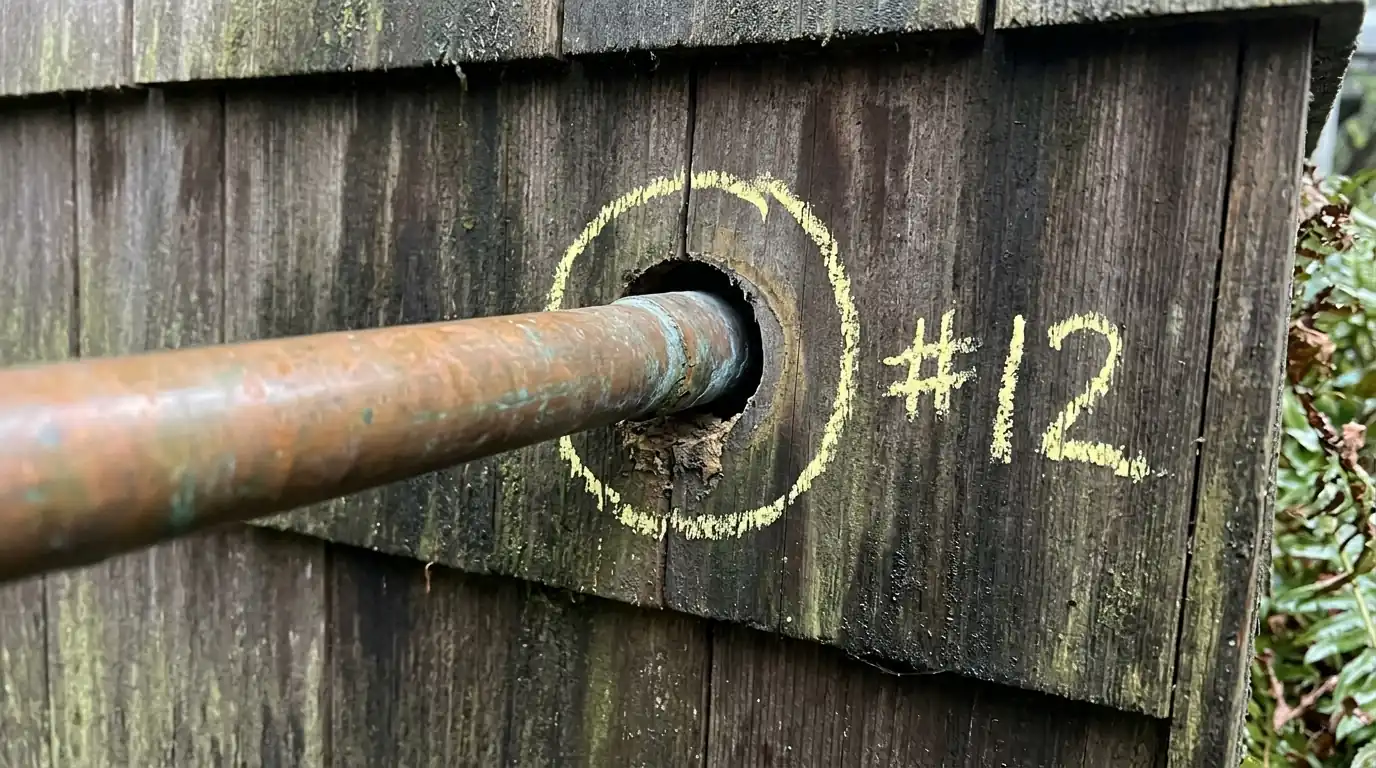
Where plumbing, gas and cable enter, the drilled hole is nearly always larger than the pipe. The crescent gap beside it is rat-size.
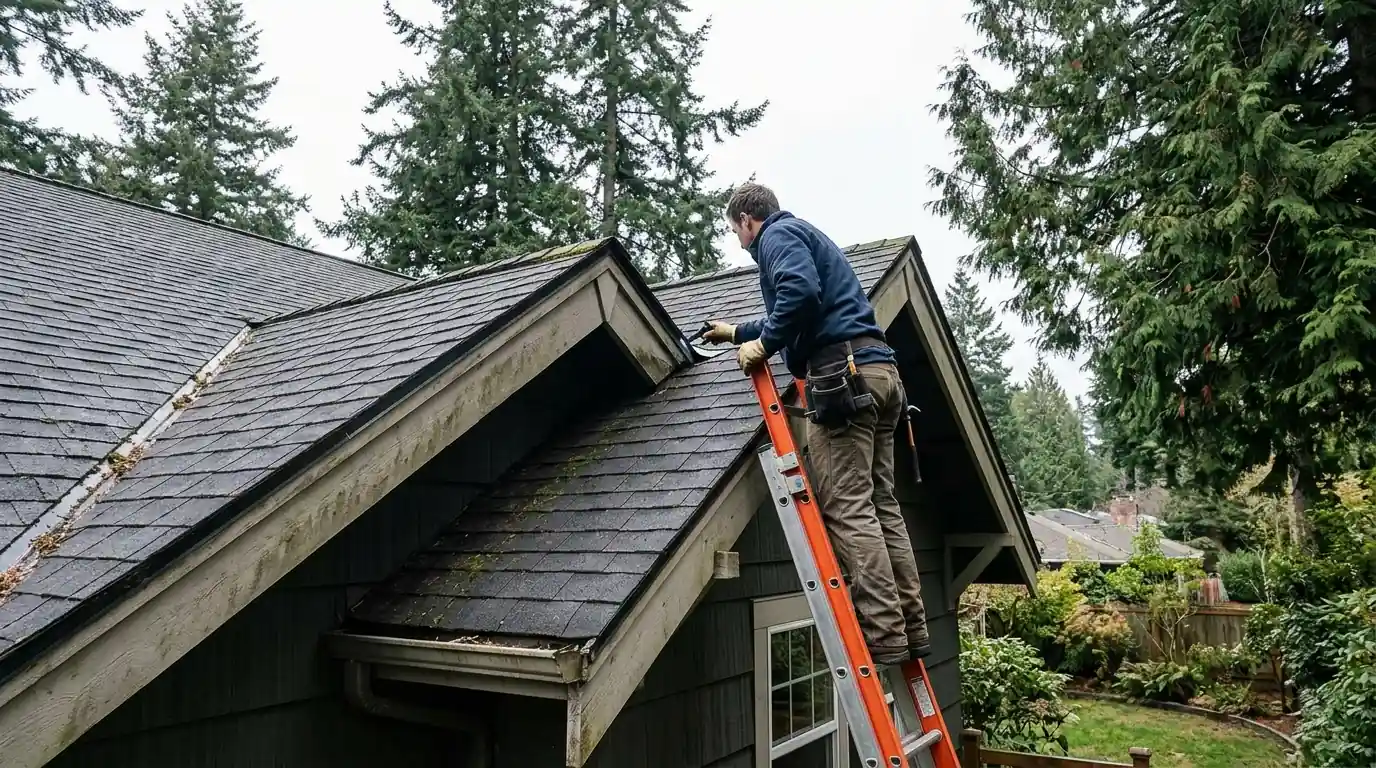
Where rooflines meet or siding meets soffit, construction gaps hide above sight line. Roof rats find them in a night.
The bottom corners of a garage door rarely seal against the slab. Gnawed weatherstripping widens the gap each season.
Exterior flaps stick open with lint or lose their louvers. An open four-inch duct is a rodent expressway.
Hatches warp, hinges sag, and the gap along one edge quietly becomes the main entry for everything below the house.
The Seattle angle
Exclusion is more valuable in Seattle than almost anywhere, for two structural reasons. First, the housing stock: with a large share of the city's homes built before 1980 and nearly one in ten before 1940, original vent screens, settled sills and decades of added penetrations are the rule, not the exception. Second, the crawl spaces: roughly 62 percent of Seattle single-family homes sit over a vented crawl space whose entire purpose is airflow, which means a ring of screened openings at exactly rodent height, each screen only as good as its corrosion state.
The payoff is equally local. With the city ranked among the nation's busiest rat metros and pressure peaking every October through February, a sealed envelope is the difference between a quiet winter and an annual trapping bill. We schedule a lot of exclusion work in late summer and early fall for exactly that reason, though the work is effective in any season.
How the job runs
Every opening a quarter-inch and up gets found, photographed and numbered, from vents to roofline.
You see the gap list with photos and a single price. No per-hole surprises mid-job.
If animals are active, trapping or one-way doors run first so nothing is sealed in.
Hardware cloth, stainless mesh, metal flashing and rated sealant, matched to each opening.
After photos for every numbered point, plus maintenance notes for the few parts that age.
Honest numbers
Published Seattle figures put targeted exclusion at roughly $209 to $627 and whole-home sealing at $500 to $2,000, and our quotes land on the gap list rather than a flat guess. What moves the number:
Exclusion pairs naturally with active rodent work: when booked alongside rat or mouse control the survey is already done as part of that inspection, and the combined quote reflects it. Either way the number is written, itemized and fixed before the first screen comes off.
| Targeted seal | Whole-home exclusion | |
|---|---|---|
| Best for | A known entry or two after an infestation | Older homes, greenbelt lots, repeat pressure |
| Scope | The specific gaps trapping identified | Every quarter-size-plus opening on the envelope |
| Documentation | Before and after photos of each point | Full numbered map of the sealed envelope |
| Published range | $209 to $627 | $500 to $2,000 |
Make the visit count
Straight answers
In this city, often yes. With published data putting rat sightings around 5.6 percent of Seattle homes and the metro ranked 12th nationally for rodent treatments, a pre-sealed envelope on an older house is cheaper than the first infestation it prevents. The survey will tell you honestly whether your house is tight already.
Through foam, in a single night; rodent incisors handle anything softer than mild steel. That is why every seal we place is metal-first, with hardware cloth or sheet metal carrying the load and sealant only finishing the joint.
Rats exploit existing openings far more than they create them; gnawing through intact siding or concrete is rare. Seal the existing quarter-size inventory and the house stops being the easy option on the block.
Not with the sequence we run. Active jobs get trapping first or one-way doors on the main entries, which let animals exit and not return. Only confirmed-quiet openings get a permanent seal.
Yes, and this matters. Crawl space ventilation prevents the moisture problems that invite carpenter ants and rot, so vents are screened with quarter-inch hardware cloth, never blocked. Airflow stays; rodents do not.
The metal is effectively permanent; galvanized and stainless components outlast the siding around them. Weatherstripping and door sweeps are the only wear items, and we note their expected life in the handover.
Seal it once, in steel, before the fall rush.
Call (206) 944-0849
Talk to a technician
One survey, one written quote, one day of sealing, and a photo set that proves every gap is shut. Call to book the walk-through.
Call (206) 944-0849Answered 24/7 from our Seattle service office.
Find the office
Our service office sits at 1440 5th Ave in Seattle, with the head office over in Aberdeen. Calls route to a person, not a queue, any hour.